

Lundi the Trooper | Four Weeks After Her Injury
- 29 April 2026
-
15
-
-


An Update from Adine Roode, HERD Founder.
Lundi has been nothing short of a trooper.
On the 29th of March, a moment in the mud changed everything. Sebakwe pushed her hard, not out of malice, but in a forceful attempt to take over the space where she was stuck. Elephants are powerful animals, and sometimes they misjudge the consequences of that power. In this case, the result was devastating. Lundi sustained a deep, penetrating wound in her axilla, the area between her chest wall and her front leg, extending an estimated 50 to 60 centimetres internally. She lost a frightening amount of blood.
The Injury and First Treatment
I received the call while the situation was unfolding. By the time Dr Rogers arrived, the bleeding had fortunately slowed, but the injury itself was severe and could not be left untreated. Lundi was placed under standing sedation, a technique that allows an elephant to remain upright while calmly sedated. It worked exceptionally well. This made it possible for Dr Rogers to work safely underneath her body, flushing the wound thoroughly and assessing the extent of the damage.
The wound was wide, about 20 centimetres at the opening, and not sterile. Some sutures were placed to stem the bleeding and reduce what had initially been a large, gaping injury, but a small drainage opening was deliberately left. This may seem counter-intuitive, but in deep wounds, drainage is critical. Trapped blood and serum create the perfect environment for infection. Lundi was given long-acting antibiotics and strong pain relief, first by injection and then orally.
The Herd Responds
Despite the pain, Lundi carried on. She was sore, yes, but the herd responded instinctively. For the first few days, they stayed close to the homestead, avoiding long walks so she wouldn’t have to push herself too far. She secreted quite a bit from her temporal glands because of the wound initially, a normal response, but by day four, that had already reduced. Her walking also slowly improved and I guess she has less pain, or got used to it, although we gave her oral painkillers.
Sebakwe’s Unexpected Response
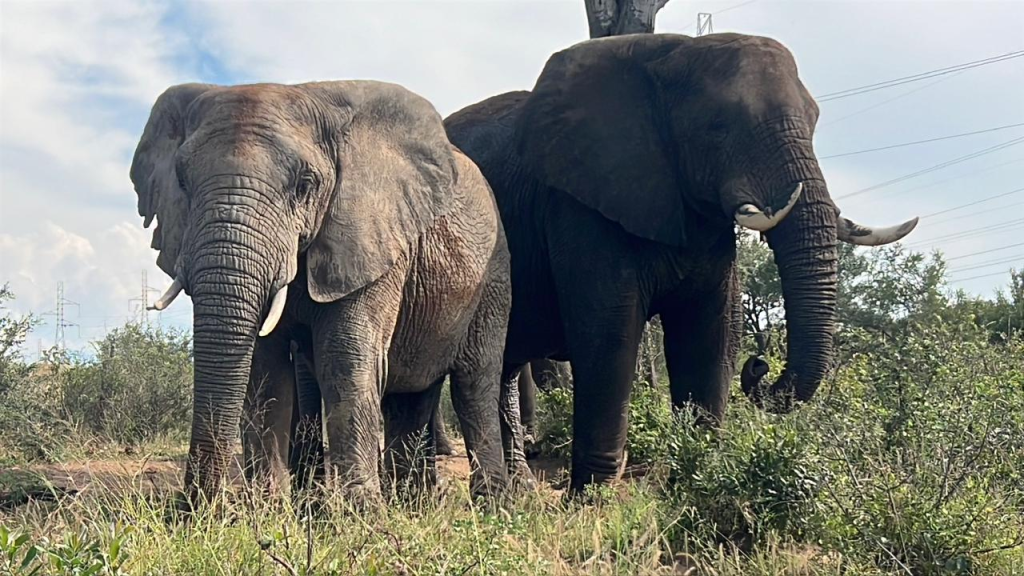
What none of us expected was her response to Sebakwe. You might think she would avoid him, or show fear. Instead, the very next day, he walked up to her, stood beside her, and gently reached out with his trunk, investigating the wound while smelling it. Lundi allowed him there. She was calm. Comfortable. There was no aggression, no tension, no animosity. Since then, they have continued to be near one another, as they always were.
We chose not to interfere. We watched carefully, but we trusted the elephants to resolve this in their own way. This felt like a one-off, and I remain convinced that Sebakwe never intended to cause such harm.
Ten Days On: A New Concern
For days, the carers cleaned Lundi’s wound diligently, using F10 Germicidal Spray to reduce bacterial contamination and discourage insects. About ten days later, however, there was a change. A large amount of pus appeared, and swelling developed under the right side of her belly, likely fluid tracking downward due to gravity. The skin felt warm to the touch, a sign that infection could be brewing.
I asked Dr Rogers to return for a deeper clean. When he did, a significant amount of pus was released, and one of the sutures was removed to improve drainage. It was a necessary step. This was never going to be a short-term healing journey.
Introducing Hypochlorous Acid
Around this time, I decided to introduce hypochlorous acid (HOCl) into her wound care. HOCl is a substance our own immune systems produce naturally to fight bacteria. Unlike normal saline, it actively reduces microbial load without damaging healthy tissue. I had used it before and, after reading the research again, felt confident it would benefit Lundi. Studies show that HOCl irrigation can significantly reduce bacterial colonisation and accelerate healing in deep and contaminated wounds when compared to saline alone, precisely because it lowers bacterial burden without increasing pain or tissue irritation (Namviriyachote et al., 2026¹).
The carers now flush Lundi’s wound twice daily using HOCl, applying it deep into the wound with a syringe and tubing. In the mornings, before the elephants head out, they also spray F10 Germicidal Spray. We cannot keep a wound like this perfectly clean, mud and dust are unavoidable, but the fact that it continues to drain is a good thing. Drainage prevents abscess formation.
Anaemia and Recovery
Two weeks after the injury, blood results confirmed what we already suspected: Lundi was anaemic. Given how much blood she lost initially, this was no surprise. A blood transfusion was briefly considered, but by the time the results arrived, she was already improving clinically. Dr Rogers felt she was recovering adequately on her own, and I agreed.
The Tetanus Risk
One concern that weighed heavily on Dr Rogers’s mind was tetanus. Tetanus is caused by Clostridium tetani, a bacterium found everywhere in the environment, in soil, dung, and dust. It thrives in deep, oxygen-poor wounds, exactly the kind Lundi had. Once established, it releases a powerful neurotoxin that causes muscle stiffness, lockjaw, spasms, and ultimately respiratory failure. It is almost always fatal.
While tetanus has historically been associated with Asian elephants, more recent scientific literature has now documented one case in an African baby elephant as well, reinforcing that this risk cannot be ignored (Platner et al., 2025²). Prevention is far safer than cure.
After discussing this with Dr Rogers and Dr Marais, we decided to vaccinate Lundi. As Dr Marais explained, it is much like a horse stepping on a nail: if the wound seals over, it creates the perfect anaerobic environment for tetanus. Even though Lundi’s wound is open and draining, its depth still posed a risk. A tetanus vaccine is inexpensive, safe, and potentially life-saving.
Lundi received her tetanus vaccination on 24 April, with a booster planned in two to three weeks.
Four Weeks On
Now, four weeks on, the wound is still open at the bottom, exactly as it should be, draining well, with swelling steadily reducing. The sutures have been removed, as they are no longer serving a purpose. Dr Rogers is pleased with her progress. I believe the introduction of HOCl made a meaningful difference.
Lundi continues to eat well, remains calm during treatment, and allows the carers to flush the wound thoroughly each day. She stands quietly, patient and resilient, embodying exactly what we mean when we say she is a trooper.
This is not a short-term healing process. But every day, she shows us just how strong she is.
Scientific References
¹ Namviriyachote, N., Hema, A., Tianwattanatada, S., Chinaroonchai, K., Kittidacha, S., & Muangman, P. (2026). Hypochlorous acid versus normal saline solution for the cleansing of indeterminate-depth burn wounds: A randomised controlled trial. Burns Open. https://doi.org/10.1016/j.burnso.2026.100446
² Platner, L., Dreyer, S., Marchewski, J., Dorner, M., Schraub, S., Lawrenz, A., Köhler, K., Staszyk, C., & Fischer, D. (2025). Tetanus in an African Elephant (Loxodonta africana). Presented at the Zoo and Wildlife Health Conference, Győr, Hungary. https://www.researchgate.net/publication/392910721_Tetanus_in_an_African_Elephant_Loxodonta_africna


Christiane
Hello Adine and a huge Hello to Dr. Peter and Lundi as well! All my love, hugs and kisses go to Lunds...our beautiful TROOPER who is recovering from her injury. I'm so glad to see that Dr. Peter has found another avenue to travel...HOCI. I didn't think this was going to be easy and I know it takes some time to see improvement or decide to try another way to go. Whatever it takes is well worth it. Lundi is an integral part of this Herd and is needed...and she sure is loved! I do hope Sebakwe will be OK. I believe he spends time with her now and that is great. They are great friends and should remain that. I know NOTHING was meant. I hadn't remembered that they were o muddy ground. Perhaps that helped to get him even closer than he meant to be. I'm sure he could have slid into her. Please continue to update us on her injury and his demeanor.
Jackie Disch
Thank you for the update, Adine. The size and depth of the wound was much larger than I envisioned. I'm so glad you and others are there to competently care for Lundi and her wound. I've been wondering (and worrying) about Sebakwe's welfare. It's a great relief to hear that it truly appears to be a one-off. Moreso, to learn that the relationship between Lundi and Sebakwe has not changed, well, that just show how remarkable these two elephants are - individually and together. With love and gratitude, Jackie
Anne
Dear HERD team. I wrote when Lundi suffered her injury, telling you about Robin, our llama who suffered a similar injury to Lundi. We did the daily cleansing of the wound in Robin's side and our vet attended frequently after the initial (standing but tranquilized) operation. The amount of pus removed was extraordinary. I wish we had known about the hypochlorous acid treatment. Anyway, I think you are doing brilliantly but you are not out of the woods yet with dear Lundi. Robin had his accident in November and the wound was going steadily down from the size of a dinner plate to half the size of my little finger nail when poor Robin simply laid down and died. This came out of the blue as he appeared in fine fettle the evening before - eating and drinking well, happy and relaxed. I send this in love, hoping that Lundi has a swift and total recovery. Peter Rogers is a fantastic vet. Our paths crossed in 2010 when we were in South Africa - what a lovely and talented human being!! Sending love to Lundi,and Sebakwe. Anne x