

Fishan’s X-rays and Treatment for his Injured Leg
- 14 May 2026
-
12
-
-


Adine’s Reflection – 12 May 2026
There are moments in conservation that test not only what we know, but who we are.
Since early 2025, my journey with Fishan has been one of deep learning, collaboration, and emotional resilience. Caring for an elephant with a chronic injury is not straightforward. There is no single solution, no perfect answer. Instead, it is a path of constant consultation, observation, and small, thoughtful decisions made every day in his best interest.
Over the past year, we have spoken with veterinarians, specialists, pharmacologists, and regenerative therapy experts from South Africa and abroad. Coordinating these conversations hasn’t always been easy, between fieldwork, travel, and the realities of working in the bush, but each discussion has added a piece to a very complex puzzle.
At HERD, we believe deeply in collaboration. No single opinion holds all the answers. But when knowledge comes together, we can shape something better, something that truly serves the elephants.

Understanding Fishan’s Reality
When Dr Gerhard Scheepers visited, his insights helped refine our understanding of what Fishan is facing.
Fishan’s injury is not simply a joint problem. It is far more complex. Years ago, he suffered a fracture that likely never healed completely. Instead of solid bone repair, a fibrous connection formed: a weaker, flexible bond between the bone ends. Each time he walks, that connection is placed under strain. It doesn’t break entirely, but it doesn’t fully heal either. It is a cycle of strain, recovery, and strain again.
This changes everything about how we manage him.
The priority is simple in theory, but difficult in practice:
Reduce strain, while preserving quality of life.
We’ve adapted his environment to support him. Sand mounds in the homestead allow him to rest while leaning, making it easier for him to get up without pushing excessive weight through his injured leg. Watching him gently rest his head against trees during the day, shifting weight ever so slightly, reminds me how instinctively animals adapt when they must.
We’ve also adjusted his movement. While elephants naturally walk vast distances, Fishan cannot. Limiting his daily range helps protect his leg, while still allowing him to engage with the herd, feed naturally, and enjoy the dam, where water offers him brief relief through buoyancy.
Water, we are learning, may be one of our greatest allies.
Balancing Pain and Protection
One of the hardest truths in veterinary care is this:
Sometimes every option carries its own risk.
To manage Fishan’s pain, we rely on medication known as anti-inflammatories. These drugs, like Meloxicam and Previcox, reduce pain and swelling, improving comfort and mobility. However, they come with a cost. Increasing the dosage may ease pain, but it raises the risk of serious side effects, particularly stomach ulcers.
So we walk a delicate line, treating enough to keep him comfortable, but not so much that we cause further harm.
Alongside medication, we’ve explored nutritional support. Traditionally used joint supplements aim to protect cartilage within joints, but in Fishan’s case, the primary issue lies deeper, in the bone itself.
This led us to rethink our approach entirely.
With the help of my son a veterinarian, Dr Xander van Eeden, and a veterinary pharmacologist, we began developing a more advanced formulation tailored specifically for Fishan. Instead of focusing only on joint lubrication, this new approach targets multiple pathways:
• Reducing inflammation, using natural compounds like Boswellia and omega-3 fatty acids
• Supporting tissue health, through collagen and essential nutrients
• Modulating chronic pain signals, with compounds such as PEA (Palmitoylethanolamide), which helps manage long-term, nerve-related pain
The goal is not to “fix” the injury, we know that may not be possible.
The goal is to slow the progression, reduce discomfort, and maintain dignity in his daily life.
Even something as simple as taste matters. Fishan is sensitive, and if he refuses the supplement, it doesn’t matter how good it is. So we adjusted not only the science, but the flavour too.
Care is never just clinical. It’s personal.
What the X-rays Revealed
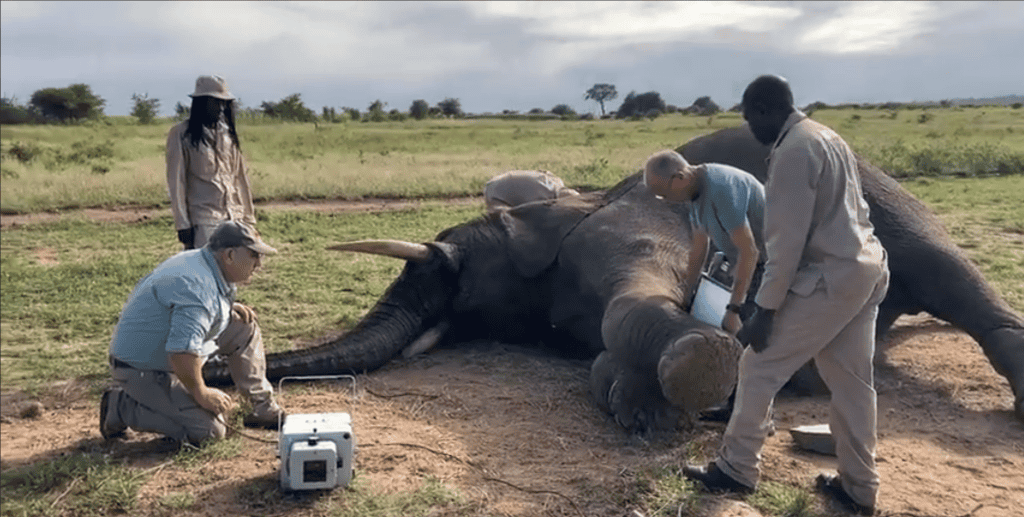
When Dr Johan Marais visited to take X-rays, we hoped for clearer answers.
Working with a five-ton elephant is never simple. Sedation must be precise, timing must align with the herd, and every movement requires planning. Fishan lay down during the procedure, which made handling the equipment easier, but afterwards, we could see the toll it had taken. He was more sore, more withdrawn, struggling to keep pace.
The X-rays themselves confirmed what we had suspected:
• Signs of osteoarthritis in the joint
• Long-term structural changes following the original fracture
• Contracted tendons and ligaments that can no longer be corrected
In simple terms, his leg has adapted over time to protect itself, but in doing so, it has become permanently misaligned.
One promising avenue we are now exploring is Pentosan, an injectable treatment that works differently from standard anti-inflammatories. Rather than just relieving pain, it helps protect joint structures and may support healing processes. It offers hope, not as a cure, but as another tool to improve comfort.
Looking Beyond Conventional Care
We are also exploring innovative therapies.
In India, facilities like Vantara Sanctuary are pioneering hydrotherapy for elephants. These systems use water, buoyancy, and targeted pressure jets to relieve joint stress, improve circulation, and support rehabilitation.
There is very little formal research available, but the observational outcomes are encouraging.
Watching elephants in water, moving more freely, leaning into the pressure of jets, even playing, it becomes clear that water offers both physical and emotional relief.
We are working to understand whether something similar could be adapted for HERD.
The Hard Conversations
In every long-term case like this, there is a conversation that sits quietly in the background.
One we do not rush.
One we do not take lightly.
The possibility of euthanasia.
It is the hardest decision any of us in conservation will ever face, the moment where compassion means letting go.
I am not there.
Not yet.
But I carry that awareness with me, because loving an elephant also means being responsible enough to recognise when suffering outweighs quality of life.
We have walked this road before, and I know what it takes from the team, from me, from the herd. I am not ready to relive that pain. But I also know that our responsibility is to the elephant first.
Fishan, Still Himself
Despite everything, Fishan remains deeply connected to his world.
Recently, as two bulls, Zindoga & Somopane, challenged each other, he charged forward instinctively, still asserting his place in the hierarchy, still protecting, still present. It came at a cost; he was more sore afterwards, his movement more strained.
But in that moment, he was not a patient.
He was an elephant.
And that matters.
Moving Forward
This journey is not about finding a single answer.
It is about continuing to ask the right questions.
We will keep adapting his environment.
We will keep refining his treatment.
We will keep learning, from experts, from research, and from Fishan himself.
Most importantly, we will keep showing up for him every day, with care, honesty, and respect.
Because at HERD, that is what we owe them.


Shirley
I have profound respect for you, Adine, and your entire team. You deeply care for these elephants yet you approach problems like Fishan's health with an open mind, objectivity, curiosity and intellectual rigor. And mountains of love. You are an example to us all. I love that big Fish and I know that, come what may, you will have done everything in his and the herd's best interests. Bless you.
Joan
I have no monetary gift to send, but I do share all your posts. I love elephants; always have since a little girl going to zoo & feeling so sad that they were in cage or small open cages to be watched. No way to even pet them. I was so happy to find your posts & have followed you for a couple of years now. Keep up the great work that you all do for these beautiful animals. I am 82 yrs. old & wish I could have joined you in your work or even started a new one somewhere that didn't have a sanctuary for these beautiful beings.
Nathalie
Thank you for the depth of love and presence and care you all engage to manifest this level of support to the elephants. I am gratefull to have the opportunity to meet them and learn about and from them even at this distance. Watching Fishan in a water hole on a cooler day asperging himself with water and mud to bring relief to his body, i noticed something as his head turned toward the camera while you were explaining his action. I saw a spark in his eyes bringning my attention to the fact that he was spraying his back with what looked like clay. Clay or even any earth mixed with water as a deep anti inflammatory and remineralising effect among all its properties. I have used this on myself and family and friends. Such strenght Thank you Fishan for being And again to all of you Blessings from Québec, Canada Nathalie